
Exploring Male Trauma in Film and TV: The Unnoticed SA Representation We Keep Asking For
Introduction
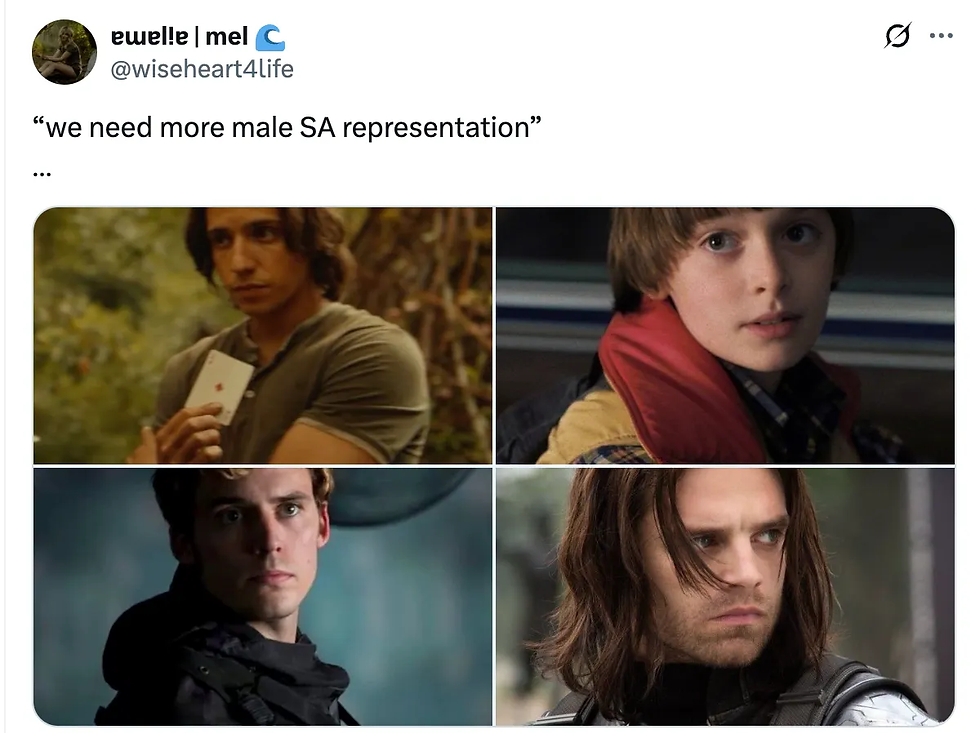
I’ve recently been seeing a lot of TikToks and posts made about wanting to see more SA representation for men. It shocked me that we hadn’t had any representation. With the rise of awareness and what some people wanna classify as “woke” culture. I would’ve figured we would’ve had some by now. It took me a while to realize that we DID have male SA representation in film, it's just that nobody cared to recognize them as such. Many people believe that men can't be SA since they’re “stronger” or “tougher”. The same gender roles and standards that are setting us back. People go about their lives viewing media and assume that if it's not blunt or shown, then it never happened. In reality, there are so many films where a little bit of critical thinking can lead you down gruesome but necessary rabbit holes. This all led me here, to writing this. The main thing I want everyone to take away is that just because a metaphor is subtle in what it's trying to display, it doesn’t mean it's not displaying anything. It's important that we take a step back and spend time to acknowledge these metaphors and it's important that we take a step back and give recognition to the male characters, and men in our lives, who have had to experience an unforgettable trauma. Without recognition, we can't grow past things like this as a society. We can't wish for more emotionally intelligent men if we aren’t willing to teach them to recognize their emotions and that trauma is just as valid as any other.
Understanding Male Trauma
So what exactly is “Male Trauma”? Male trauma refers to the emotional and psychological impact of traumatic experiences on men. Unresolved male trauma can lead us down a cycle of mental health, aggression, and violence. It can also lead to difficulty with emotional intimacy and strains on communication.
In modern-day and older societies, men are and were expected to be strong and providers. They often are pushed to suppress their emotions and anything society deems unmasculine. They are meant to be people who can take on and handle anything. Sexual actions are things they are supposed to crave and desire.
I've witnessed these things personally, but especially in the film industry. Specifically, an example of this could be with the shaming of men like Drake Bell, who came out about his childhood SA, or the praising of men like Billy in Stranger Things, who is lusted over by the older women in his community. Society and Gen. Pop. view these men and their situations as things to be desired and proud of. When a man comes out or displays that he has fallen victim to the grooming and abuse of another person, man or woman, we as a collective hesitate to view it as true. We hesitate to accept it as a part of reality or that it's something that could have the same toll on men as it does on women.
The reluctance of society as a collective to validate and recognize the stories being shared with us is just a reflection of the way we were conditioned. This reason alone is a big reason why I believe that metaphors are such a necessary tool in how we share these stories.
The Power of Metaphors in Storytelling
Metaphors are devices meant to help us drive the narrative beyond literal plots. They are meant to utilize characters, situations, and objects to really drive deeper meaning into media. They bring out hidden messages without overpowering our main plot and story. The usage of symbolism and metaphors have been used ubiquitously across different forms of media to help us break down complex and hard-to-describe thoughts and feelings into more digestible tidbits. They bring deeper and more nuanced subjects back up to the surface and push for more tangible understandings of how these events could affect us and how they could affect our lives.
I've always been an enjoyer of blunt and simple media. I like contemporary books where things are told directly. I like music that tells a boring story in boring ways. But every once in a while I take to a film or show that could be blunt but chooses not to be. I get to experience the same emotions that being blunt could invoke, but instead in a more artistically aware way. I get to feel these emotions deeper as my brain fights to unravel the hidden message. I believe it is films like that that grow us as an artistic society. It is the media that can lead you to reflect more on your emotions and what deep down you are feeling, which leads to our collective growth. It is an art form in and of itself that helps us to build upon those critical theories, leading us to develop our natural skill and instinct to dissect and inspect.
Analyzing Key Examples in Film and TV
1. Symbolic Narratives
There are a lot of pieces of film that hold a male character as their SA representation. Some notable pieces that include a character like this are Stranger Things, The Black Phone, or even Supernatural. These three all carry forms of Male SA representation and male trauma without leading to our plot and story being overpowered or overthrown. Men are represented in a way that doesn't take away from their story. Their SA isn't a part of their personality but instead just an aspect of their life.
Will Byers
In Stranger Things 1, including the first 5 minutes of Stranger Things 5, we are directly given the information that Will is possessed by the Mind Flayer and Vecna. Although we aren’t directly told that it's meant to be anything sexual, the metaphors of Will’s nonconsensual bodily usage are still strong and there. With Will saying things like “I tried. I tried to make it go away. But it got me mom.” We get to see the aspects of refusal. Will is being tormented by his violation even late after their trauma-causing event actually ends.
Quotes like “I felt it everywhere. Everywhere” are more direct showings of his bodily usage. That specific quote is the one that pushes a small possession over the edge and onto boundary-breaching territory. Not to say that Will had much say in his boundary, but that's precisely the point. Will didn't get the say. We view these scenes and want to chalk them up to a supernatural being possessing a boy for his usage, but imagery and syntax are important aspects of all films.
Even when it's not told to us directly through his words, we as a collective can understand and sense the feeling of violation. We as a whole can feel the intrusion and the discomfort and guilt that come with it. Although SA is never the victim's fault, it's not uncommon for victims to feel a sense of guilt. As if they could have prevented it at all.
Finn Blake
In Black Phone 1, we are being introduced and brought through the story of all the young boys being taken by the Grabber. Specifically were taken through the story of Finn Blake and his experiences before, during, and after his kidnapping had taken place.
Multiple times in the film, we are given hints of The Grabber's ulterior motive regarding young boys. We hear him express wanting to look at the boys he takes, he expresses his desires loud and clear. The Grabber directly says to Finn, “I will never make you do anything you won't like.” This isn't just a line from a kidnapper; it's a line from a man justifying his abuse of boys.
Although Finn's trauma isn’t directly told within the movie, we, like with Will Byers, can feel his suffering as well as see the repercussions and aftermath of his trauma. This is especially true in The Black Phone 2. We get to see Finn, a previously very bullied boy, turn violent and get into constant fights. We see him turn away from his family and close off his sister, just for us to later see that it's due to his trouble coping with what he experiences.
Violence and extreme outbursts are key factors and signs that a man has been forced to live through a traumatic event that no boy or person should ever have to. Finns' urge to get into fights within the second Black Phone movie isn't just because he's growing up and aging; it's a direct response to the lack of control he had when he was younger and invaded.
Sam Winchester
My last strong example of this would be through Sam Winchester and his experiences of being nonconsensually used as a vessel throughout season 9 of Supernatural. With the quick progression of supernatural, we don't really get to see the repercussions and effects of his possession, but we still witness the effects it has on his mental state during the time.
Sam is constantly slighted to believe that everything he thinks, feels, and witnesses within his own mind isn't true. We go with him on this journey of constantly feeling as if he's made to be crazy. Throughout his possession, he's constantly gaslighted into thinking that what he experiences isn't what he sees. Gadreel actively sends Sam to a “happy place”. In sexual assault and abuse, it's common that many victims develop their own false sense of reality known as a “happy place” where they can go and feel as if they are escaping their violation
Through Sam's violation as a vessel, we get to witness how things like SA can affect men who aren't given the space to be open and comforted. Those meant to be his support system are directly going against him. They are the people making his SA feel like more than a bodily violation, but also a breach of his trust.
2. The Role of the 'Quiet Suffering' Male Character
The ‘quiet male lead’ is a new up-and-coming role that many directors have taken a strong liking to for their films and movies in recent years. A “quiet suffering male lead” is a character who endures significant amounts of emotional and psychological pain and turmoil without putting his feelings on display.
These characters often include subtle cues towards their suffering, such as melancholy tones or dramatic outbursts. They often build up to violent outbursts or distrust in the people around them. Once these feelings are finally brought to the surface, we usually see a large amount of emotional backup release. We see large scenes of crying and confessions. We finally get to see the men with “tough exteriors” break and reveal that their trauma impacted them, the same way it would impact anyone else.
I believe that my examples, the strongest and most direct, would be Finn Blake. There was no symbolic or metaphorical assault, just implied. Yet he still went just as overlooked as any other character. Although the three examples I’ve chosen to dive into are all strong and encapsulating examples, they aren't the only ones.
I’ve personally taken to resonating with Charlie Spring from Heartstopper. A character who has been pressured into their act by people they were and should have been safe with. Charlie was made to feel as though if he didn't continue meeting with a man he didn't want to meet with, then he'd be outed. It's not a metaphor or implied; it's directly there. Yet people still glossed over it. I resonated with the peer pressure. I understand what it's like to feel the need to say yes to everything to survive high school and not be bullied.
3. The Future of Male Representation in Media
As more people raise awareness of this ongoing phenomenon, I wouldn't be surprised if we saw a shift in the way our men are represented in these films. As creators begin joining the discussion and engaging with the versatility of masculinity, seeing male characters who aren't defined by their pain tolerance may become more common in the future.
We started with characters like Sam Winchester and ended with characters like Charlie Spring and Finn Blake. We could finally be moving towards the open acknowledgement of the trauma pushed onto men and finally leaving the hidden metaphor phase.
Viewers today are more capable and suffering deeper with their ideas of media literacy. People are struggling to read between the lines but excelling at knowing there are lines to be read between. While this may be one direct reason why things like male SA have to be borderline spelled out for us now, it's also part of the reason why people are finally beginning to discuss the topics we always should've been discussing.
sources
The Black Phone (2021) — Directed by Scott Derrickson
Stranger Things (2016 – Present) — Created by Matt Duffer and Ross Duffer
Supernatural (2005 – 2020) — Created by Eric Kripke
@wiseheart4life — “'We need more male SA representation’ …” X (FormerlyTwitter), Nov. 8, 2025. https://x.com/wiseheart4life/status/1987103532261257286?s=20
Comments